
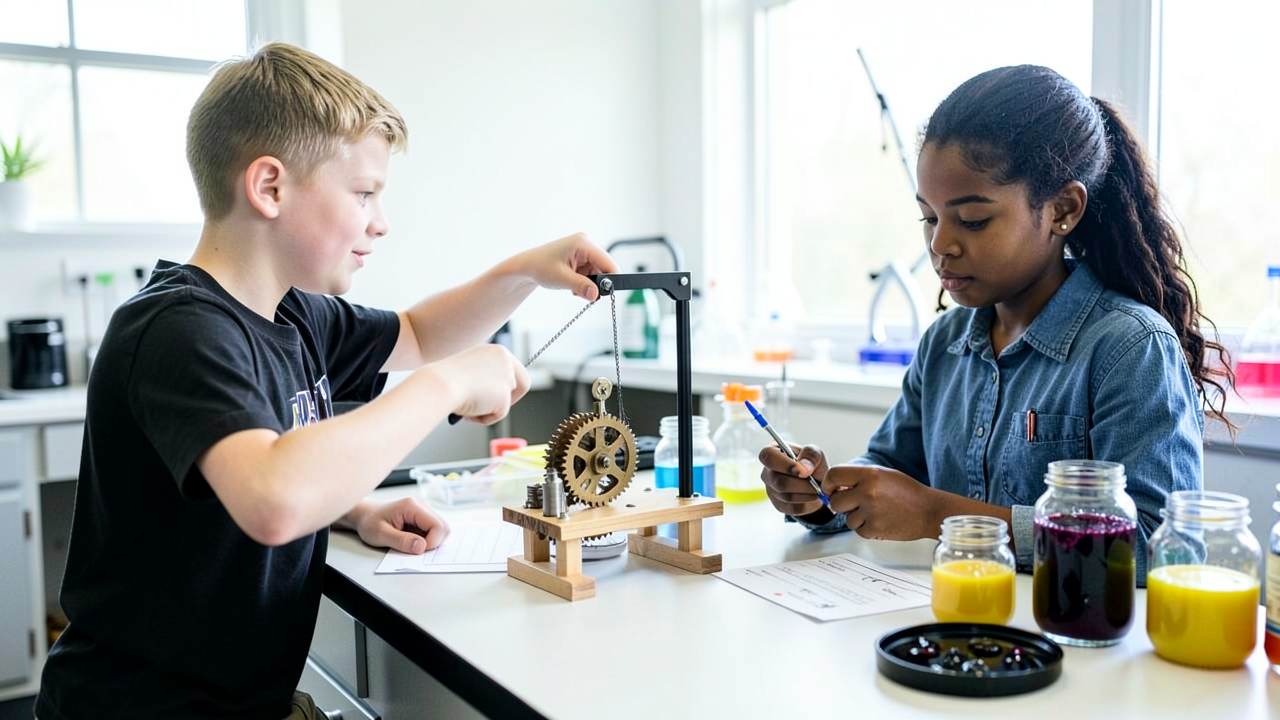
Atoms to Machines
Atoms to Machines answers a simple question with twelve weeks of experiments: how does science become stuff? Students begin as formulation chemists, engineering frozen desserts to hit a texture target, mixing and stress-testing their own adhesives, and racing to clean a simulated oil spill -- learning phase changes, solubility, and polarity because the products demand it.
The middle of the course shrinks the scale a billion-fold. Students explore the nanoworld, where surface area overwhelms volume and familiar materials gain startling new behaviors, and they debate where nanotechnology in medicine, electronics, and energy helps or harms. Then the course zooms back out to the physics of machines: levers, pulleys, gears, and their compound descendants, measured and modeled until force-versus-distance trade-offs feel like second nature.
Everything converges in an invention studio capstone, where teams analyze an everyday mechanism, prove a measurable improvement, and present their invention with the notebooks, data, and simulations to back it up -- the same evidence trail used by working chemists, materials scientists, and mechanical engineers they meet along the way.
View the full lesson plan — all 60 periods →
Course structure — 3 units, 4 weeks each
In every unit, weeks 1–3 build the skills and week 4 applies them in a project, with a deliverable due at the end of each day.