
Code & Command
Code & Command is the payoff course of the elementary sequence: in twelve hours fourth and fifth graders stop just using technology and start commanding it. It opens inside the machine, tracing inputs, processing, outputs, and storage through familiar devices and pairing that systems literacy with digital citizenship. A timed game sprint puts it to work as teams design and playtest games for younger students. Energy and materials-science lessons follow, where students engineer energy-conversion devices for real client needs and write repeatable test protocols judged against pass-fail criteria they set themselves.
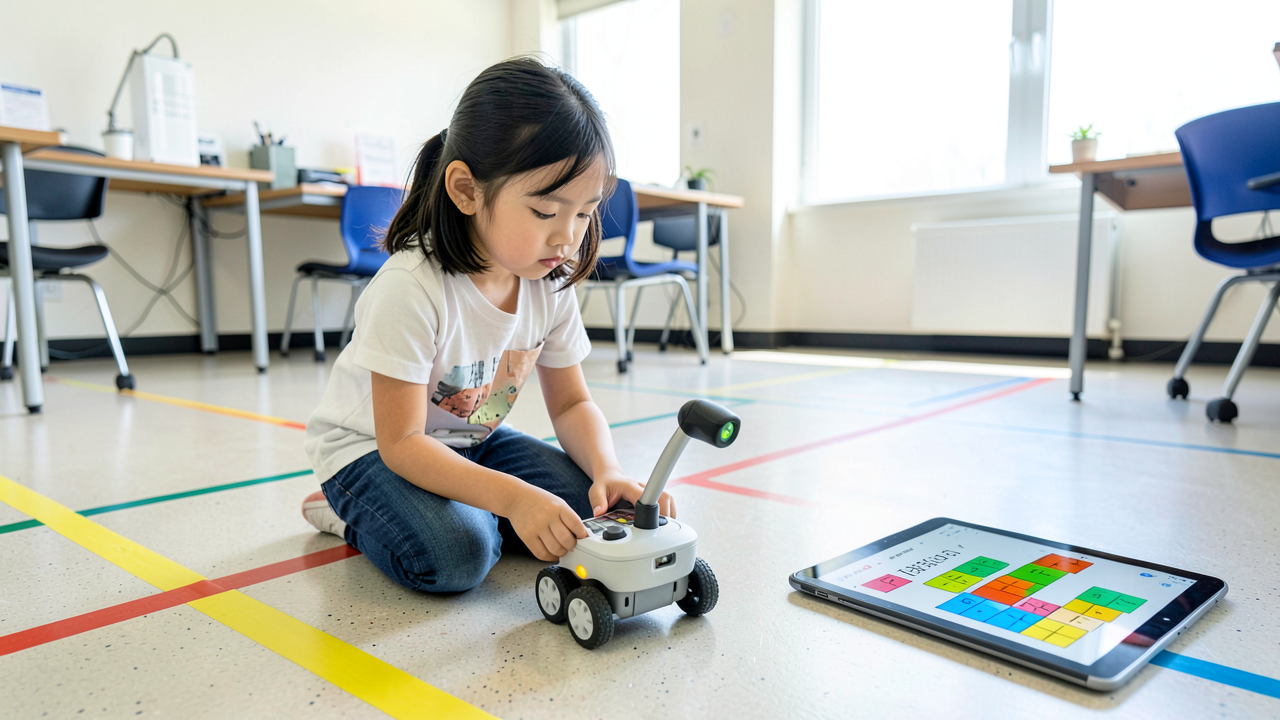
The back half belongs to robots and models. Students assemble and drive robots through precision challenges, choosing gears and manipulators for the job, then remove themselves from the loop entirely: sensors, conditionals, and calibration runs turn the same machines into autonomous delivery vehicles. The finale is computational modeling, where students program an agent-based disease-spread simulation, sweep parameters, run repeated trials, and turn the output into prevention recommendations backed by evidence.
Documentation runs through everything: engineering notebooks, test logs, and public demos give every student a portfolio and a stage. Because each lesson learns an idea and immediately commands something with it, students leave ready for middle school design, robotics, and app-building with habits most programs postpone until much later. Beyond ordinary classroom supplies the course draws only on durable equipment a school buys once: a robotics kit, tablets or laptops, thermometers, spring scales, and a camera that shoots slow motion.
View the full lesson plan — all 12 lessons →
Course structure — 12 one-hour lessons
Every lesson splits its hour evenly: half spent learning the idea, half spent making something with it.