
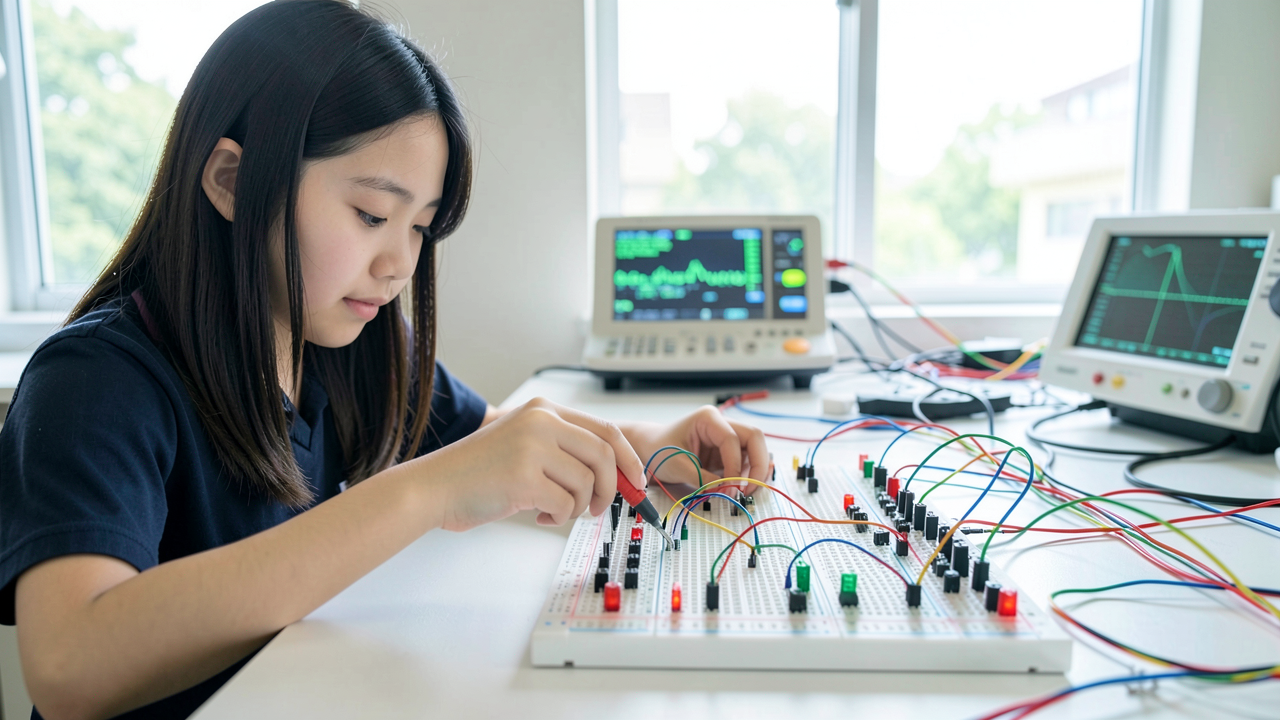
Digital Logic & Circuits
Digital Logic & Circuits reveals the machinery under every computer: voltage, logic, and state. Students begin at the component level - reading resistors, breadboarding, measuring with meters - and end the year implementing their own designs on programmable logic hardware and microcontrollers.
The core of the course is disciplined digital design. Students learn to speak binary and hexadecimal, derive Boolean expressions straight from truth tables, and minimize them with algebra and Karnaugh maps before a single chip goes in a socket. Circuit simulation runs alongside every physical build, so students verify designs virtually, then prove them on real 74-series hardware with oscilloscopes and logic analyzers.
Sequential logic brings circuits to life - flip-flops, counters, shift registers, and full state machines designed from diagram to hardware. The final unit moves designs onto programmable logic devices and microcontrollers solving real-world control problems, with systematic troubleshooting and professional schematic documentation as the habits that carry it all.
View the full lesson plan — all 180 periods →
Course structure — 6 units, 6 weeks each
In every unit, weeks 1–5 build the skills and week 6 applies them in a project, with a deliverable due at the end of each day.