
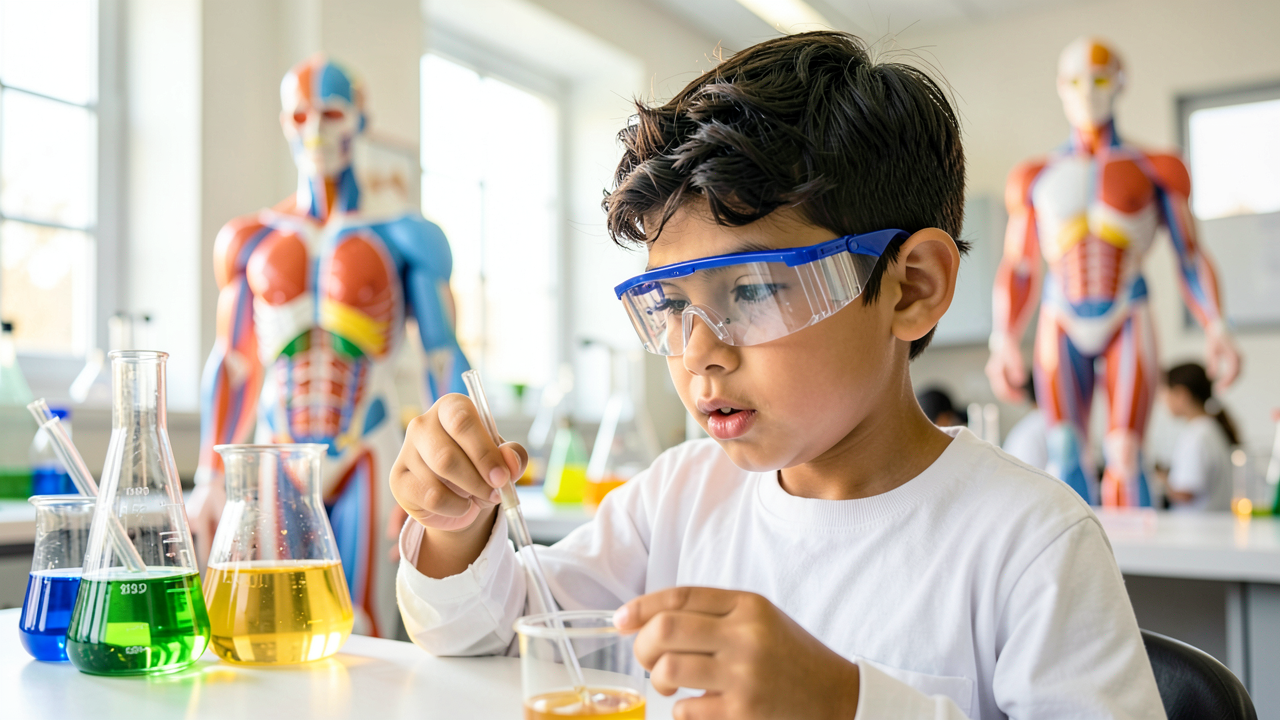
Growing Healthy Scientists
Growing Healthy Scientists is the elementary on-ramp to the biomedical pathway: twelve hours arranged as a grade-progressive journey through the science of keeping bodies well. The early lessons start with what children can touch and feel: how food fuels growth, how big movement builds muscle, how germs travel from hand to hand, and where the heart, lungs, and bones live and what they do. The first design challenge makes the science personal — read an X-ray, then model, build, and test a cast for a broken arm.
The later lessons grow into genuine investigation. Students chart inherited traits across modeled generations, design an organism suited to a target environment, build and function-test a model prosthesis for an injured animal, and trace nerve signals from stimulus to response, producing their own media piece on concussion safety. The course ends with the class as a public-health team: a fair-test germ-spread experiment, a mystery agent deduced from evidence, an outbreak traced to its source, and a programmed disease-spread simulation whose output backs a prevention briefing to the community.
A health-scientist portfolio spirals through all twelve lessons, so a student who begins by sorting healthy choices finishes able to argue from experiment and simulation evidence — a straight line toward our middle and high school biomedical courses. Every activity uses ordinary classroom supplies plus the durable equipment schools already keep: a body model, printed X-ray images, magnifiers, a stopwatch, and tablets. Nothing requires a specialist consumable.
View the full lesson plan — all 12 lessons →
Course structure — 12 one-hour lessons
Every lesson splits its hour evenly: half spent learning the idea, half spent making something with it.