
Health Case Files
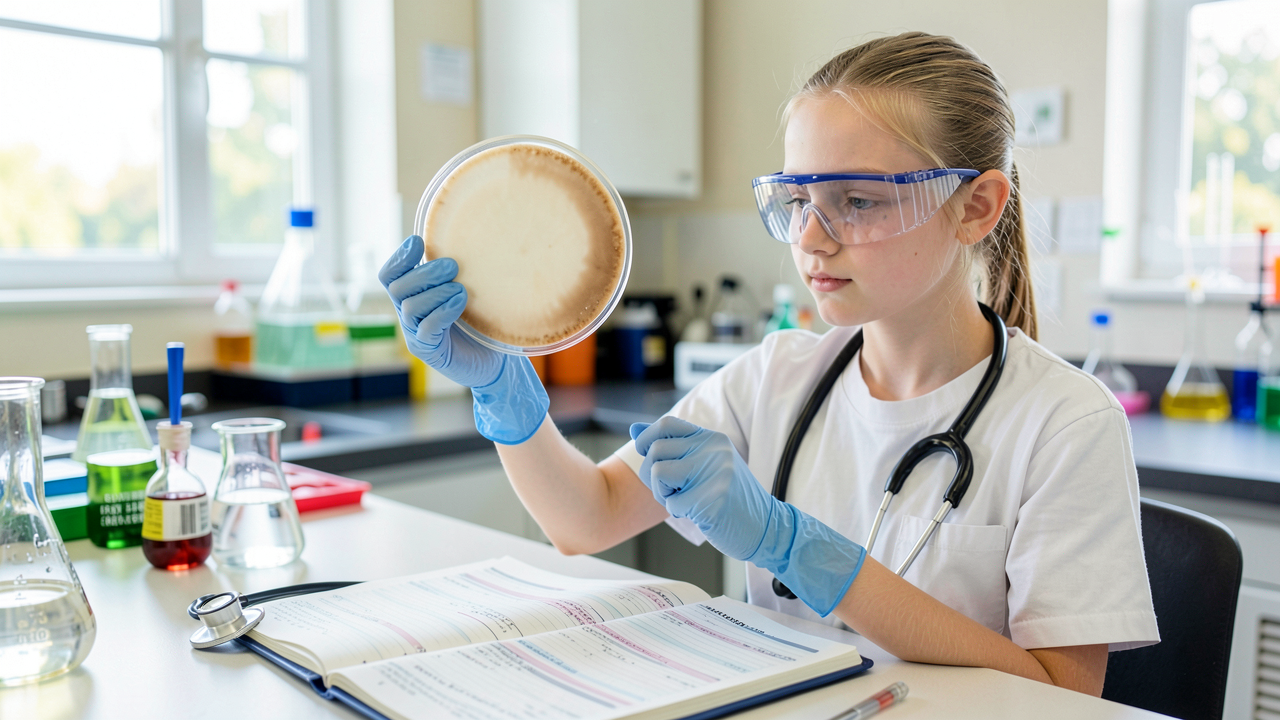
In Health Case Files, every unit opens a new case folder. Students play the role of medical investigators: taking real vital signs with stethoscopes and blood pressure cuffs, judging readings against healthy ranges, and learning why a single number never tells the whole story. Sterile technique and agar plates turn the classroom into a working micro lab, where students culture microbes safely and run their own experiments on what actually stops bacterial growth.
The middle of the course builds the anatomical backbone. Students map how organ systems depend on one another, follow a signal from stimulus through neuron to brain and back out to muscle, dissect a real specimen brain to see the regions they have modeled, and translate what they learn into education materials a real patient could understand. Then the cases darken: mystery toxins disrupt body systems, and students analyze simulated patient samples and population symptom data to find the culprit.
The capstone is a full outbreak investigation -- tracing a contamination source through maps, patient histories, and lab results, reconstructing how it spread, and briefing community decision-makers with an evidence-based action plan. Students finish with a case portfolio and a grounded view of careers across medicine, nursing, laboratory science, and public health.
View the full lesson plan — all 60 periods →
Course structure — 3 units, 4 weeks each
In every unit, weeks 1–3 build the skills and week 4 applies them in a project, with a deliverable due at the end of each day.