
Wings & Rockets
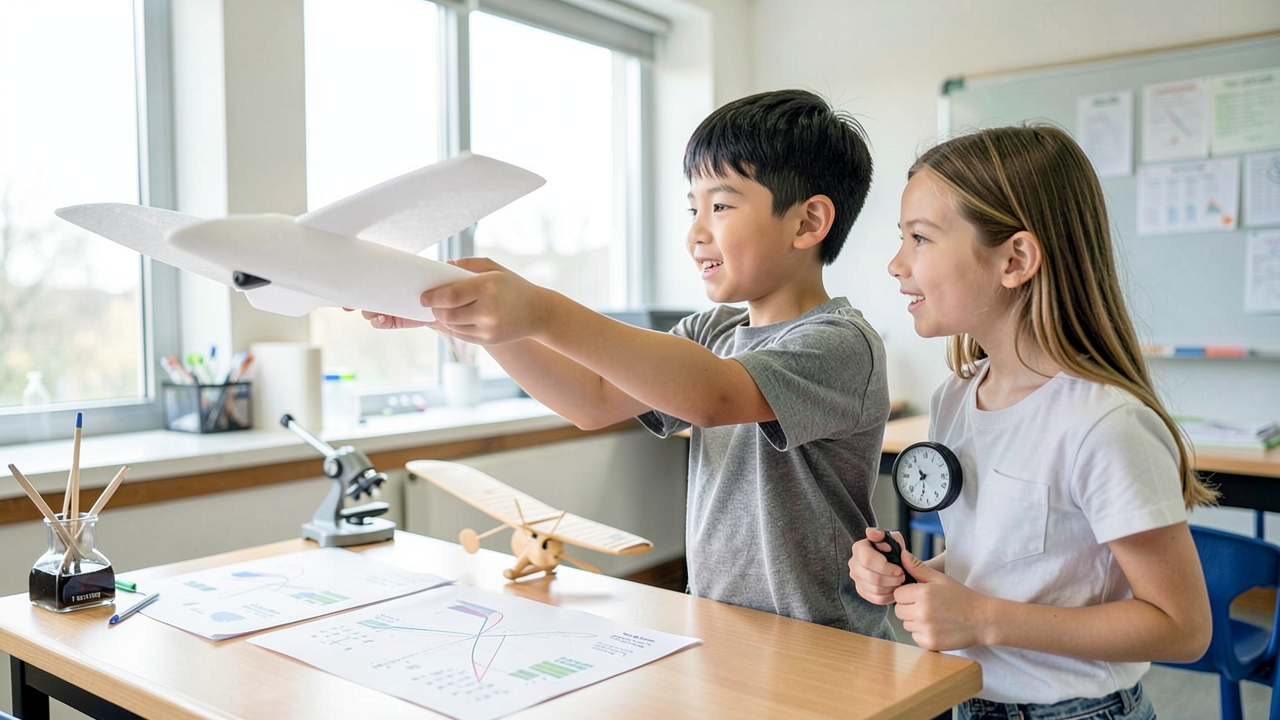
Wings & Rockets carries students from the first wobbly glider toss to a full crewed Mars mission proposal. The course begins with the physics of staying aloft: Newton's laws, the four competing forces on an aircraft, and hands-on wing and control-surface experiments where students change one variable at a time and let flight data pick the winner.
Students then step into aviation operations, reading pilot navigation charts, computing distance, fuel, and time for planned routes, coordinating a simulated airport, and scheduling operations on Gantt-style timelines before surveying how uncrewed aircraft are reshaping careers in the field. Rocketry follows: action-reaction propulsion, propellant-versus-performance modeling, and repeated launch campaigns where each design revision must be justified by the previous round's numbers.
The final unit leaves the atmosphere. Students study orbits, atmospheric layers, and historic crewed missions, then investigate how humans eat, exercise, and survive off Earth, including closed-loop air and water recycling. Everything converges in a capstone where teams assemble an integrated Mars mission plan and defend its trade-offs before a review panel.
View the full lesson plan — all 60 periods →
Course structure — 3 units, 4 weeks each
In every unit, weeks 1–3 build the skills and week 4 applies them in a project, with a deliverable due at the end of each day.